Credit Service Center Modernization
Credit Service Center Modernization
Credit Service Center Modernization
A legacy associate-facing credit tool, barely changed since 2006, was modernized — but not before research revealed the real problem wasn't the interface. It was the people using it.
A legacy associate-facing credit tool, barely changed since 2006, was modernized — but not before research revealed the real problem wasn’t the interface. It was the people using it.
A legacy associate-facing credit tool, barely changed since 2006, was modernized — but not before research revealed the real problem wasn’t the interface. It was the people using it.

Role
Role
Role
Year
Year
Year
Timeline
Timeline
Timeline
Impact
Impact
Impact
UX /Product
Designer
UX /Product
Designer
UX /Product
Designer
2025
2025
2025
14+ Months
14+ Months
14+ Months
55% of StoresHit Quota
55% of StoresHit Quota
55% of StoresHit Quota
TL;DR
The short version — if you're in a hurry
TL;DR
The short version — if you’re in a hurry
75% of stores were missing the monthly credit quota — the brief called for a UI modernization
Store visits revealed the real bottleneck: associate confidence and knowledge, not the interface
The brief was reframed to include the associate's point of view before design began
Two design directions were explored — associates validated the better version, engineering flagged a backend constraint"
Shipped the good version with progressive disclosure as a mitigation; documented the best version for future phases
After full rollout: 55% of stores hit quota, and associates beyond the credit champions began initiating credit conversations
75% of stores were missing the monthly credit quota — the brief called for a UI modernization
Store visits revealed the real bottleneck: associate confidence and knowledge, not the interface
The brief was reframed to include the associate’s point of view before design began
Two design directions were explored — associates validated the better version, engineering flagged a backend constraint”
Shipped the good version with progressive disclosure as a mitigation; documented the best version for future phases
After full rollout: 55% of stores hit quota, and associates beyond the credit champions began initiating credit conversations
**Due to confidentiality, some details and visuals have been omitted. Here are the key highlights.**
01 Context
A modernization ask sitting inside
a much bigger problem
01 Context
A modernization ask sitting inside
a much bigger problem
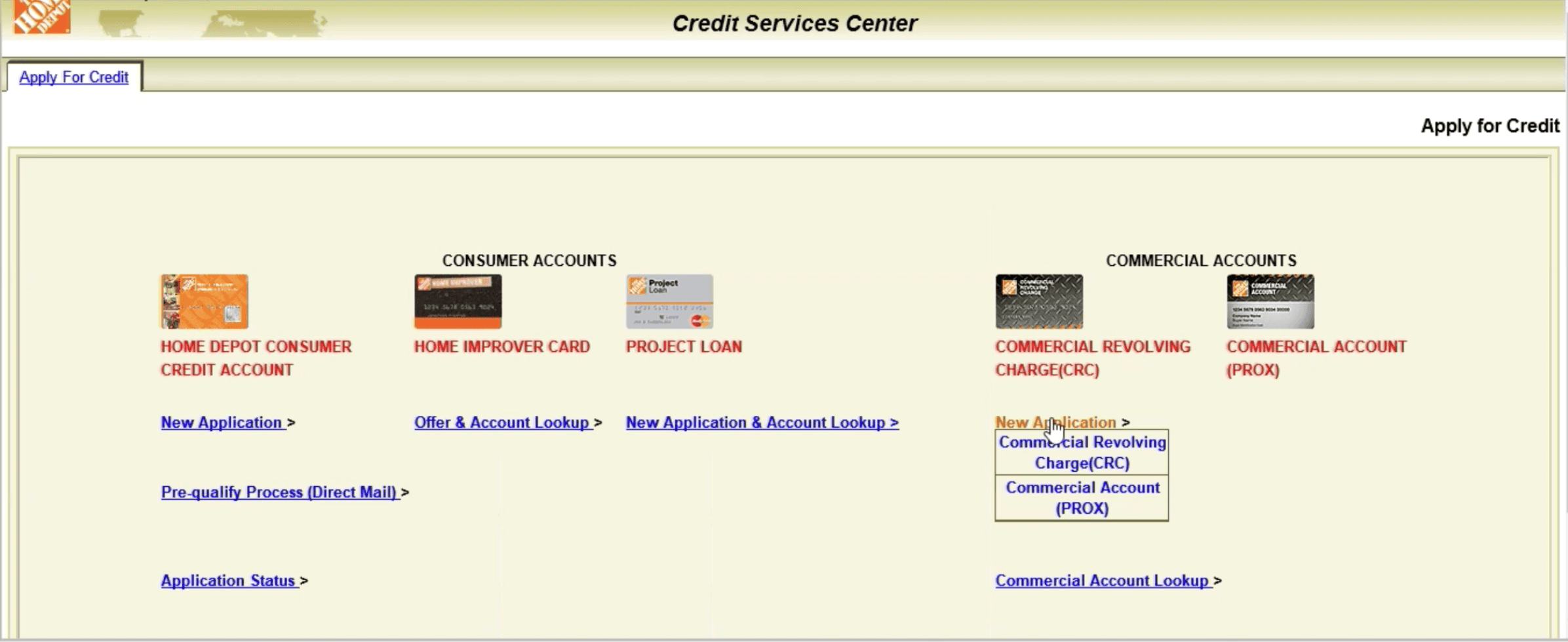
The Credit Service Center is the legacy associate-facing tool that supports 5 store-branded Home Depot credit cards with 11 applications. Each application helps an associate do one of three things: sign a customer up for credit, look up a pending or referred application status, or help a customer make a purchase when their physical card isn't present.
The Credit Service Center is the legacy associate-facing tool that supports 5 store-branded Home Depot credit cards with 11 applications. Each application helps an associate do one of three things: sign a customer up for credit, look up a pending or referred application status, or help a customer make a purchase when their physical card isn’t present.
The business context made the stakes clear. Credit matters strategically for three reasons — it reduces processing expenses, it increases customer loyalty and spending, and it gives Home Depot customer data that third-party cards can't provide. So when 75% of stores were missing their monthly credit signup quota, that wasn't just a sales problem. It was a margin problem.
The business context made the stakes clear. Credit matters strategically for three reasons — it reduces processing expenses, it increases customer loyalty and spending, and it gives Home Depot customer data that third-party cards can’t provide. So when 75% of stores were missing their monthly credit signup quota, that wasn’t just a sales problem. It was a margin problem.
My job was to modernize a legacy system that had barely changed since 2006 as part of moving it from a monolithic structure to a cloud-based one. That was the brief. What I found when I went deeper was something different.
"The brief called for a better-looking tool. The stores told me the tool wasn't the problem."
"The brief called for a better-looking tool. The stores told me the tool wasn't the problem."
Legacy CSC
02 What Made It Complex
Five cards. Eleven applications.
One bottleneck nobody had named.
02 What Made It Complex
Five cards. Eleven applications.
One bottleneck nobody had named.
The surface complexity was visible immediately — 11 separate applications organized by card rather than by function, a design that hadn't meaningfully evolved since 2006, and a monolithic backend being migrated to cloud infrastructure on a fixed timeline.
The surface complexity was visible immediately — 11 separate applications organized by card rather than by function, a design that hadn’t meaningfully evolved since 2006, and a monolithic backend being migrated to cloud infrastructure on a fixed timeline.
But the deeper complexity only became clear through field research. The system wasn't failing because of the UI. It was failing because of how associates were using and avoiding it.
But the deeper complexity only became clear through field research. The system wasn’t failing because of the UI. It was failing because of how associates were using and avoiding it.
03 Problem Framing
The original brief represented
two out of three perspectives
03 Problem Framing
The original brief represented
two out of three perspectives
The original brief represented the perspective of the business and technology. Before opening Figma, I believed the brief also needed to represent the people using the Credit Service Center. That meant going to the stores before making any design decisions.
I visited five Home Depot stores and observed and interviewed associates, store managers, and credit champions. What I saw was that associates weren't pushing credit — and I needed to understand why. When I asked store managers, they were direct: if they were hitting their quota, it was because of one person. One credit champion absorbing every credit conversation in the store.
I visited five Home Depot stores and observed and interviewed associates, store managers, and credit champions. What I saw was that associates weren’t pushing credit — and I needed to understand why. When I asked store managers, they were direct: if they were hitting their quota, it was because of one person. One credit champion absorbing every credit conversation in the store.
I interviewed those champions, and then the associates who were avoiding the conversation entirely. The champions were being sent every customer who asked about credit. The associates who weren't pushing it stayed away because they lacked product knowledge — and they didn't want to look bad in front of a customer or slow down the line.
I interviewed those champions, and then the associates who were avoiding the conversation entirely. The champions were being sent every customer who asked about credit. The associates who weren’t pushing it stayed away because they lacked product knowledge — and they didn’t want to look bad in front of a customer or slow down the line.
"The bottleneck wasn't the tool. It was confidence and knowledge — and a system that concentrated both in one person per store."
"The bottleneck wasn't the tool. It was confidence and knowledge — and a system that concentrated both in one person per store."
I brought those findings back to the internal team. Everyone aligned that the brief needed to be reframed to include the associate's point of view — while the timeline stayed the same. That reframing became the foundation for every design decision that followed.
I brought those findings back to the internal team. Everyone aligned that the brief needed to be reframed to include the associate’s point of view — while the timeline stayed the same. That reframing became the foundation for every design decision that followed.
04 Discovery & Validation
Research informed the design.
Associates validated it.
04 Discovery & Validation
Research informed the design.
Associates validated it.
With the reframed brief in hand, I designed two versions of the Credit Service Center landing page — good and better — and validated them with six associates before taking anything to engineering.
I showed the versions in order. After seeing the good version, all six said it was an improvement over the legacy design. They appreciated having the value propositions visible for each card. When I showed the better version — a consolidated view organized by function rather than by card — all six preferred it.
What they said made the finding concrete. The cluttered screen made them feel like they had to be super careful not to make a mistake. That anxiety was pulling their attention away from the customer and into the screen. They were so focused on not picking the wrong thing that they couldn't be fully present in the conversation.
What they said made the finding concrete. The cluttered screen made them feel like they had to be super careful not to make a mistake. That anxiety was pulling their attention away from the customer and into the screen. They were so focused on not picking the wrong thing that they couldn’t be fully present in the conversation.
"They weren't avoiding credit because they didn't care. They were avoiding it because the tool made them feel like they might fail in front of a customer."
"They weren't avoiding credit because they didn't care. They were avoiding it because the tool made them feel like they might fail in front of a customer."
Good Version

Better Version

05 Design Thinking
The right answer existed.
The timeline didn't support it.
05 Design Thinking
The right answer existed.
The timeline didn’t support it.
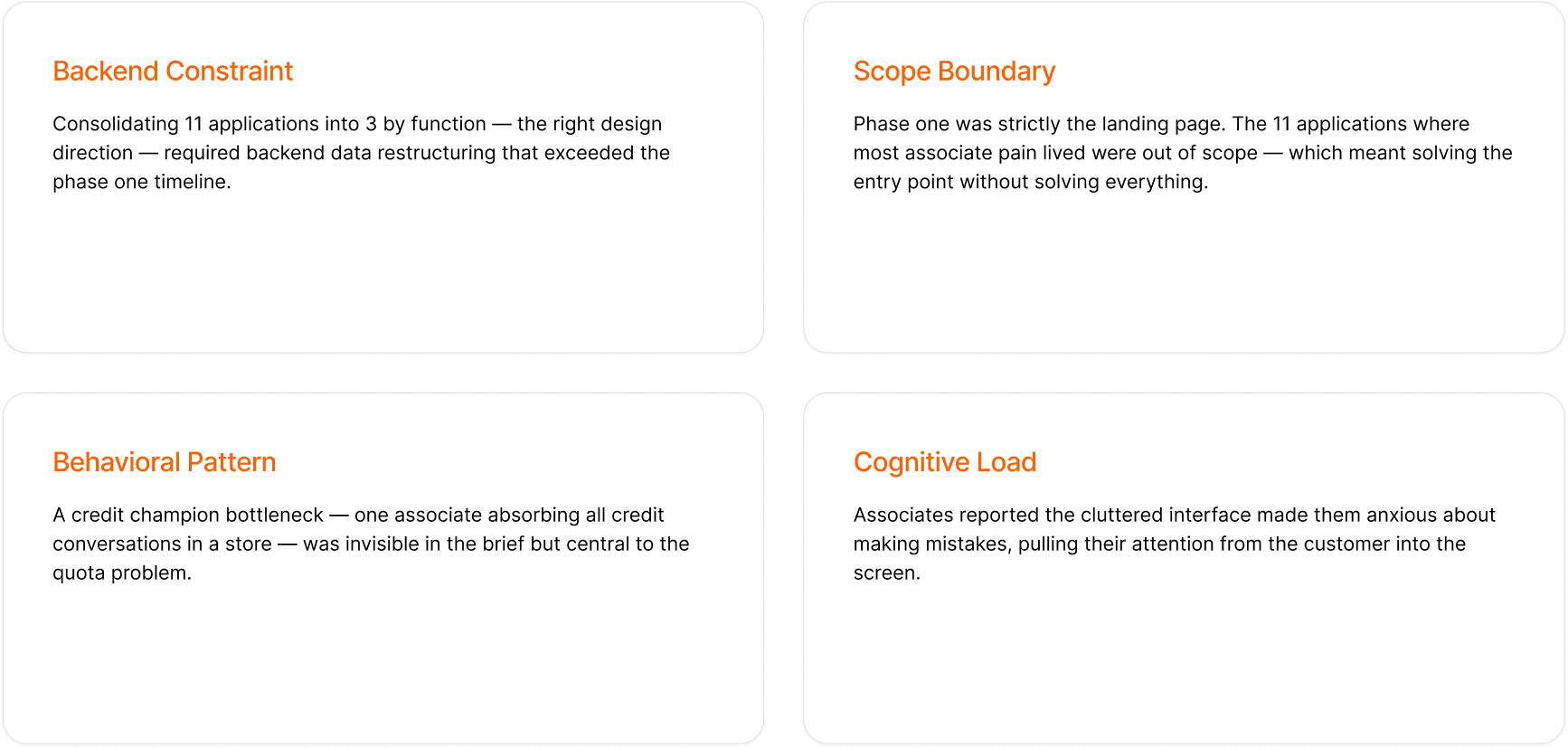
I presented both versions to engineering. They agreed the better version was the right long-term direction — consolidating the 11 applications into 3 organized by function made sense from a user standpoint, and it would reduce the number of applications they had to maintain. But consolidating the backend data to support it added time the phase one timeline couldn't absorb.
I presented both versions to engineering. They agreed the better version was the right long-term direction — consolidating the 11 applications into 3 organized by function made sense from a user standpoint, and it would reduce the number of applications they had to maintain. But consolidating the backend data to support it added time the phase one timeline couldn’t absorb.
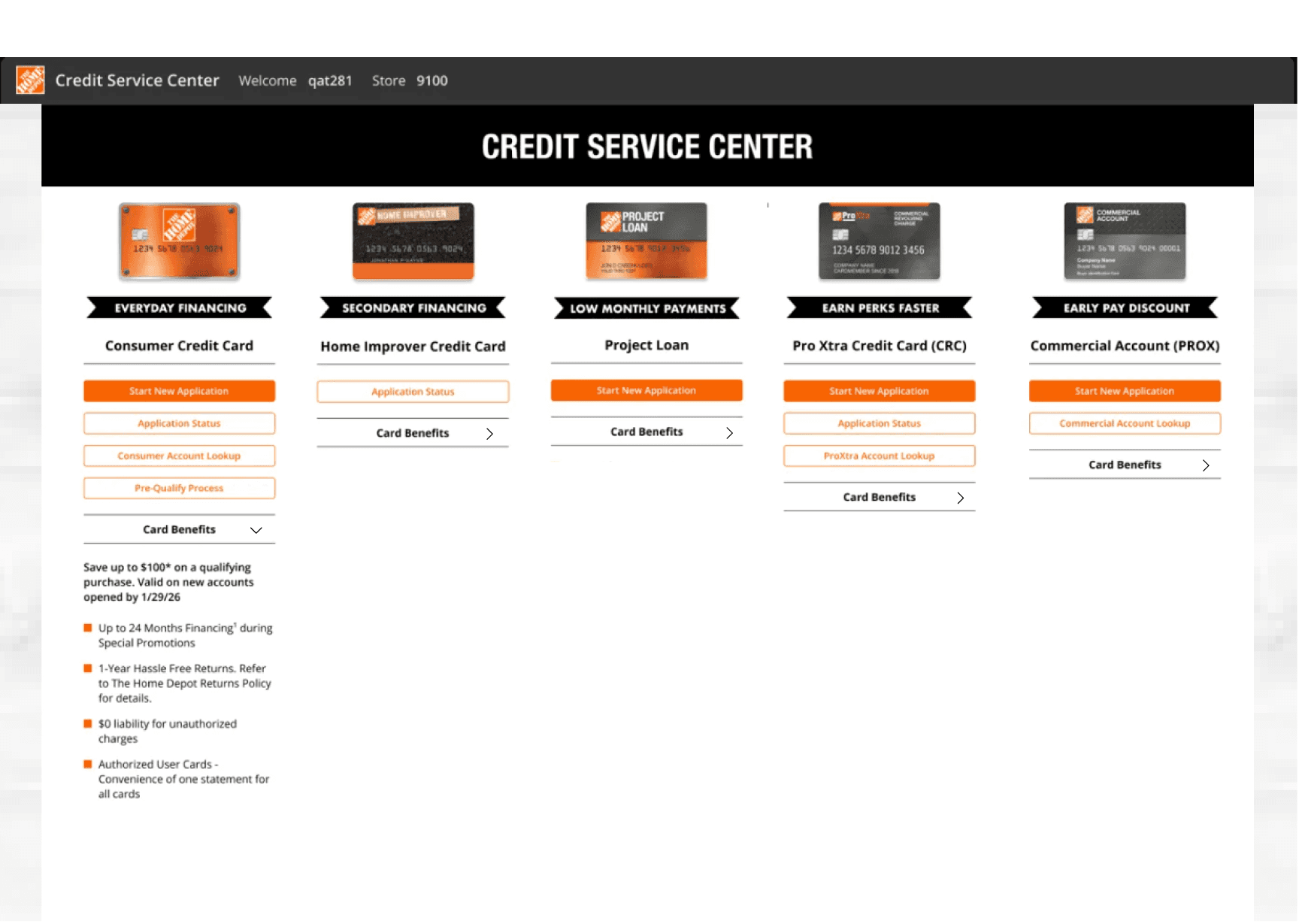
So we shipped the good version. All 11 applications remained, but I added progressive disclosure — full value propositions for each card that the associate could expand during a customer conversation and collapse when they didn't need them.
So we shipped the good version. All 11 applications remained, but I added progressive disclosure — full value propositions for each card that the associate could expand during a customer conversation and collapse when they didn’t need them.
This wasn't a compromise made without intention. The best version reduced cognitive load by eliminating complexity. Since that wasn't feasible in this phase, progressive disclosure was a way of giving associates control over the complexity rather than eliminating it. The better version was documented and flagged for a future phase rather than abandoned.
This wasn’t a compromise made without intention. The best version reduced cognitive load by eliminating complexity. Since that wasn’t feasible in this phase, progressive disclosure was a way of giving associates control over the complexity rather than eliminating it. The better version was documented and flagged for a future phase rather than abandoned.
Better version — final design with progressive disclosure
"I documented the better version so it wouldn't disappear after launch. The right answer doesn't stop being right because the timeline moved."
"I documented the better version so it wouldn't disappear after launch. The right answer doesn't stop being right because the timeline moved."
06 Execution
Build-ready design in a
constrained enterprise environment
06 Execution
Build-ready design in a
constrained enterprise environment
Working within a phased enterprise migration meant staying close to engineering throughout — not just at handoff. The application had branching paths, multiple card types, and distinct outcome states that had to be accounted for in the designs.
During engineering working sessions, I discovered the team wasn't using Home Depot's enterprise design system. They were working from a customized generic version, which was adding build friction beyond just this project. I connected them with the design system team — an intervention that improved the build process for this phase and beyond it.
During engineering working sessions, I discovered the team wasn’t using Home Depot’s enterprise design system. They were working from a customized generic version, which was adding build friction beyond just this project. I connected them with the design system team — an intervention that improved the build process for this phase and beyond it.
The progressive disclosure solution was specifically designed to be implementable within the existing phase one constraints. Every decision was weighed against what engineering could actually ship, not just what would be ideal. That tradeoff discipline — knowing what to push for and what to accept — was as much a part of the execution as the design work itself.
07 Outcome
55% of stores.
And a seat at the table.
07 Outcome
55% of stores.
And a seat at the table.
After all phases were complete, the Credit Service Center launched nationally to over 2,000 Home Depot stores. Beyond the quota number, more associates outside of the credit champions began initiating credit conversations — which confirmed the research finding. The bottleneck wasn't the tool. It was confidence and knowledge. A cleaner interface reduced the anxiety that was keeping associates out of the conversation.
After all phases were complete, the Credit Service Center launched nationally to over 2,000 Home Depot stores. Beyond the quota number, more associates outside of the credit champions began initiating credit conversations — which confirmed the research finding. The bottleneck wasn’t the tool. It was confidence and knowledge. A cleaner interface reduced the anxiety that was keeping associates out of the conversation.

The biggest signal came at the post-release retrospective. The lead engineer said: we need UX in the meetings before timelines are set on the roadmap — because Robert created a design that was really great for the user but we couldn't implement given our timeframe.
The biggest signal came at the post-release retrospective. The lead engineer said: we need UX in the meetings before timelines are set on the roadmap — because Robert created a design that was really great for the user but we couldn’t implement given our timeframe.
"Someone outside of design said out loud that the process should have included me earlier. That's the kind of influence that outlasts a single project."
"Someone outside of design said out loud that the process should have included me earlier. That's the kind of influence that outlasts a single project."
08 Learnings
Question the brief before
you execute it
08 Learnings
Question the brief before
you execute it
The most important decision in this project was made before any design work started — going to the stores before opening Figma. The brief was accurate about what the business wanted. It was incomplete about what the users needed. Closing that gap changed the direction of the entire project.
Working within a constrained timeline in a phased enterprise system also taught me that documenting the right answer matters as much as shipping the feasible one. The best version didn't disappear — it became a recommendation for a future phase. Design decisions that can't ship today can still shape what ships tomorrow.
Working within a constrained timeline in a phased enterprise system also taught me that documenting the right answer matters as much as shipping the feasible one. The best version didn’t disappear — it became a recommendation for a future phase. Design decisions that can’t ship today can still shape what ships tomorrow.
And the engineer's comment at the retrospective reinforced something I'd started to believe through the project: in enterprise environments, research isn't just a tool for design. It's a tool for influence. The pushback on the brief held because it was grounded in what I observed, not what I assumed.
And the engineer’s comment at the retrospective reinforced something I’d started to believe through the project: in enterprise environments, research isn’t just a tool for design. It’s a tool for influence. The pushback on the brief held because it was grounded in what I observed, not what I assumed.